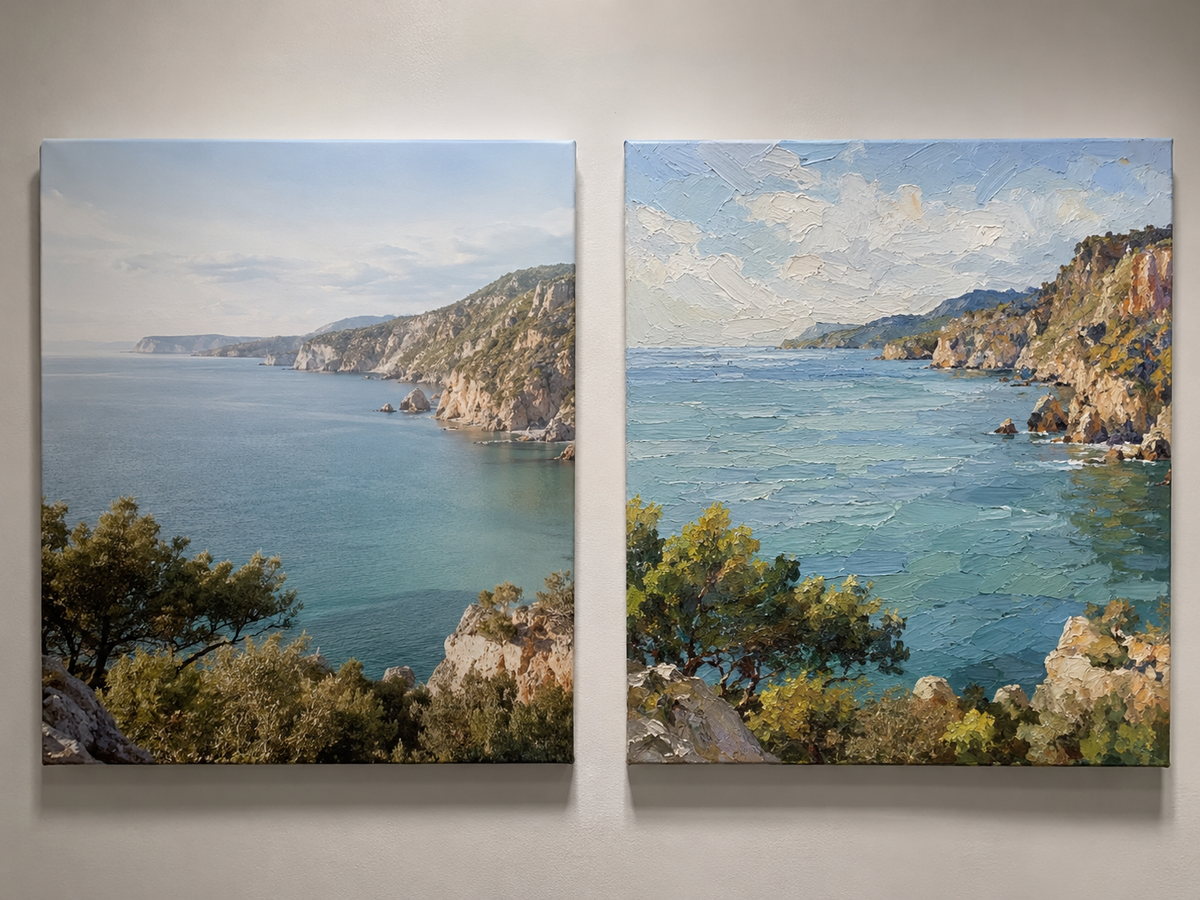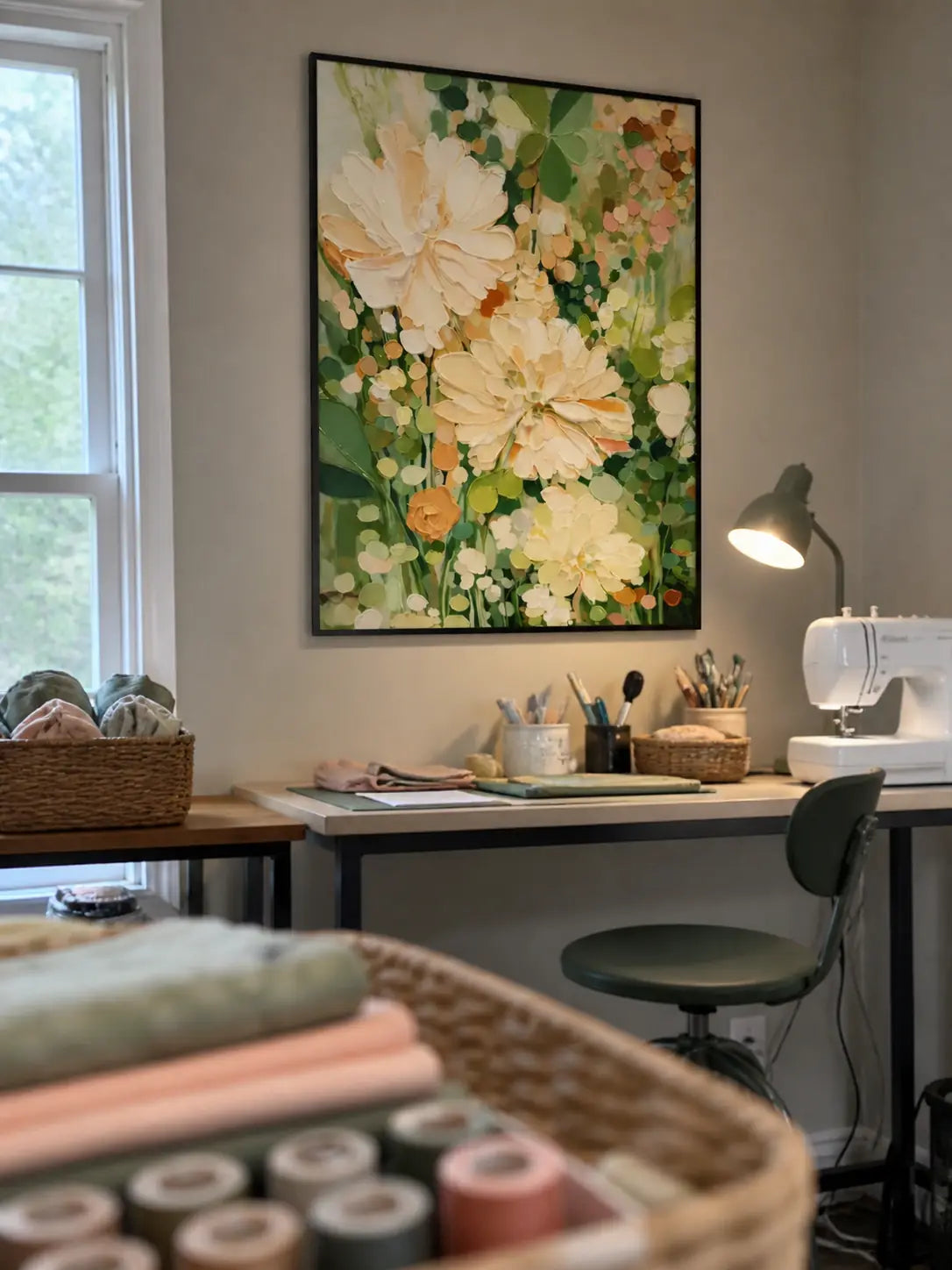
A narrow wall beside a doorway, an empty space between windows, or an unfinished reading corner deserves more consideration than whichever painting happens to fit. Start with the shape of the available wall, then compare artwork that complements the furniture and the way you use the room.
To buy vertical abstract oil paintings, explore artist studios and galleries, specialist online art marketplaces, and made-to-order art studios. Before choosing, confirm the painting medium, finished dimensions, framing, and delivery arrangements. To style your selection, consider its width as carefully as its height.
The aim is not simply to fill an empty rectangle. It is to choose a painting you enjoy looking at and give it a deliberate place in your home.

Where to Buy Vertical Abstract Oil Paintings
Artist Studios and Galleries
Start with an artist or gallery when your priority is a particular artist, an individual composition, or the opportunity to examine a work in person. Ask whether the painting is available to view, whether it is a one-of-one work, and what information accompanies the purchase.
For a commission, agree on the dimensions, palette, creative brief, and approval process before paying. Discuss whether you are requesting a new composition or a hand-painted version of an existing design.
Specialist Online Art Marketplaces
For a broader search, an online marketplace offers another starting point. For example, Saatchi Art has a dedicated abstract oil paintings category.
Compare individual listings rather than treating the platform name as a substitute for checking the artwork. Confirm the medium, artist information, actual dimensions, shipping origin, and return conditions. A portrait-shaped thumbnail is not enough: read the width and height, then check whether the displayed price includes the frame.
Made-to-Order Artwork at Rosemary Art
At Rosemary Art, we offer hand-painted-to-order artwork with options to adjust size, orientation, and color palette. Our custom artwork service also includes a free wall preview to help you compare a proposed painting with your space.
Browse our vertical paintings collection to begin with the format, or explore our abstract paintings to compare compositions. When oil paint is essential to your purchase, confirm the medium of the specific design before ordering; “hand-painted” does not identify the paint medium.
What to Check Before Buying
Confirm the Medium and Production Method
Ask what materials were used and whether any part of the image is printed. Do not treat “textured,” “hand-finished,” and “oil on canvas” as interchangeable descriptions.
A raised surface alone does not prove that an entire image was painted by hand. Likewise, a hand-painted work may repeat an existing composition rather than be a one-of-one design. Our guide to identifying a hand-painted painting explains these distinctions.
Review the Actual Artwork
Request a clear front view, close-ups, side views, and information about the back and frame. For made-to-order work, ask what photographs or video you can review before dispatch.
Use an interior mockup to explore placement, not as evidence of the finished paint surface. Also ask whether the photographed work is the exact painting for sale or an example of the design.
Compare the Complete Purchase
Compare prices at the same size and delivery format. Ask whether stretching, framing, shipping, and any applicable import charges are included. Check the cancellation, modification, return, and damage-reporting conditions for your particular order, especially when requesting customization.
How to Choose the Right Size
Measure the usable wall area rather than the entire room. Exclude door trim, switches, sconces, and space needed for curtains to open. Then ask for the artwork’s finished outside dimensions, including the frame.
All example sizes below are width × height. They are starting points for a paper mockup, not a claim that every design is available in these dimensions.
| Example size | Approximate metric size | What to compare |
|---|---|---|
| 18 × 36 inches | 46 × 91 cm | A slimmer option for a compact wall section |
| 24 × 48 inches | 61 × 122 cm | A larger alternative for the same wall |
| 30 × 60 inches | 76 × 152 cm | A statement-size option where both dimensions allow it |
Suppose your usable wall is 36 inches wide and a painting measures 24 inches wide including its frame. Centering it leaves 6 inches on each side—approximately a 91 cm wall, a 61 cm painting, and 15 cm of clearance per side. That checks the width, but you still need to assess the height and nearby furniture.
Make a full-size paper template and compare it from the doorway and your usual seated position. A digital preview is another comparison tool, but it should accompany measurements rather than replace them.
How to Style Vertical Abstract Art in Different Spaces
Above an Entryway Console
For an entryway, try centering the painting over the console rather than automatically centering it on the entire wall. Keep the first arrangement simple: one artwork, a low tray, and a small sculptural object.
As an initial mockup, test a gap of about 6–10 inches (15–25 cm) between the console and the bottom of the artwork, then adjust to the furniture, painting height, and sightline. Check that a lamp or vase does not obscure the part of the composition you most want to see.
Beside a Reading Chair
In a reading corner, consider the chair, side table, lamp, and painting as one arrangement. Try positioning the artwork in relation to that group rather than placing it in the center of a much larger wall.
View the mockup both standing and seated. Compare a quiet composition with a more expressive one, and choose the version that supports how you want the corner to feel.
Between Two Windows
Measure with the curtains open in their normal position. The visible wall may be narrower than the distance between the window frames.
Start with a painting that leaves clear space on both sides. Where curtain fabric is patterned, try a simpler abstract composition first. Where the windows and curtains are visually restrained, compare a stronger color or more active brushwork.
Above a Sofa: Consider a Pair
Do not assume one tall, narrow painting is the right answer for a wide sofa. Test a larger single piece, a horizontal composition, and a pair of vertical artworks before deciding.
For a pair, include the gap in your calculation. Two framed paintings that are each 24 inches wide, separated by 3 inches, occupy 51 inches in total, or about 130 cm. Judge that combined width against the sofa and the surrounding wall.
Choose the pair for a relationship in color, shape, or rhythm—not merely because both canvases are vertical.
On a Stair Landing or Hallway End Wall
On a landing, assess the painting from the main approach and from the landing itself. Avoid placing it high solely because the wall is tall.
At the end of a hallway, compare how the composition reads from a distance and close up. For a difficult-to-reach position, include professional installation in the plan rather than treating hanging as an afterthought.
Choosing Colors, Texture, and a Frame
Decide whether you want the painting to blend with the room or provide contrast. Instead of matching every cushion, begin with one existing reference: a wood finish, rug detail, curtain color, or accent chair.
For palette inspiration, Rosemary Art’s Cream Cocoa Minimal Abstract Painting TA#2942 combines cream, tan, cocoa, and charcoal. Try that color relationship with warm wood and neutral upholstery.
For a stronger contrast, compare the Dark Green Textured Abstract Painting TA#2945, which uses a deep green palette and curved relief lines. These are color and composition references; confirm the medium of any selected work separately.
For the frame, test a natural wood finish against timber furniture, black against dark architectural details, or a lighter finish against a pale wall. Do not choose by color alone: compare the frame’s thickness and its finished outside dimensions.
When texture matters, request side-angle photographs of the actual surface rather than judging depth from a room mockup.
Common Styling Mistakes to Avoid
Buying for height alone. A painting can fit beneath the ceiling while leaving the wall looking awkwardly narrow or crowded. Compare both dimensions before ordering.
Ignoring the frame. Measure the finished object, not just the painted canvas, especially between windows or beside doors.
Forcing a vertical format above wide furniture. Choose the format that suits the wall rather than forcing a narrow canvas into a horizontal arrangement.
Treating a mockup as an exact promise. Use it to compare options, then verify dimensions, materials, and the finished artwork separately.
Frequently Asked Questions
Can Vertical Abstract Art Work in a Small Room?
Yes, but choose according to the available wall and nearby furniture rather than the room’s floor area alone. Test more than one size. A smaller painting is not automatically the better fit, and a larger one should not crowd doors, curtains, or lighting.
How High Should I Hang a Vertical Painting?
Begin with a position that is comfortable to view from the room’s main viewing point. Above furniture, check the relationship between the furniture and the bottom of the frame. On a freestanding wall, compare the painting’s center with your sightline. Do not automatically align its top with the ceiling or doorframe.
Can a Horizontal Abstract Design Be Made Vertical?
Ask for a revised composition, not simply a stretched image. Changing the proportions may require moving shapes, adjusting empty space, or rebalancing color. Review a portrait-format proposal before approving a custom version.
Can a Large Textured Painting Be Shipped Rolled?
Do not assume so. Rosemary Art’s oversized painting shipping guide distinguishes flexible canvases suitable for rolling from heavily textured, stretched, or framed works that need rigid protection. Confirm the packing and delivery format for the specific painting before ordering.
Find the Right Vertical Painting for Your Space
Begin with the wall, choose a composition you enjoy, and verify what you are buying. The strongest choice is not necessarily the tallest painting or the closest color match—it is the one whose proportions and presence work in your room.
Explore Rosemary Art’s vertical collection, or request a free wall preview. Send a straight-on wall photo, the available width and height, and the artwork you are considering so you can compare the proposed placement before ordering.