What Is Wabi-Sabi Wall Art? The Japanese Art of Imperfect Beauty (2026 Guide)
Wabi-sabi is a Japanese aesthetic centered on finding beauty in imperfection, impermanence, and simplicity. In art and interiors, wabi-sabi wall art means hand-made, texture-rich pieces — muted colors, organic shapes, rough or uneven surfaces — that feel calm, natural, and quietly imperfect rather than glossy and mass-produced. If you're drawn to art that makes a room feel serene and grounded, this is the style you're looking for.
What does wabi-sabi actually mean?
The term joins two ideas: wabi, a subdued, understated beauty, and sabi, the grace that comes with age and wear. Designer Leonard Koren famously summarized the aesthetic as things that are “imperfect, impermanent, and incomplete.” As author Richard Powell put it, wabi-sabi “acknowledges three simple realities: nothing lasts, nothing is finished, and nothing is perfect.” For a fuller academic treatment, the Stanford Encyclopedia of Philosophy’s entry on Japanese Aesthetics is an excellent primer, and Wikipedia’s overview of wabi-sabi traces its history in depth.
Where does wabi-sabi come from?
Wabi-sabi has roots in Zen Buddhism and the Japanese tea ceremony. In the 15th century, the Zen tea master Murata Jukō began replacing ornate Chinese gold and porcelain wares with simple, rough wood and clay vessels. About a century later, the tea master Sen no Rikyū (1522–1591) brought this humble, imperfect beauty to the nobility through his stripped-back teahouse design. A closely related idea is kintsugi — repairing broken pottery with gold so the cracks become part of the beauty rather than something to hide. That single image captures the whole philosophy: imperfection isn’t a flaw to erase, it’s the story worth celebrating.
Wabi-sabi vs. minimalism: what's the difference?
They look similar but feel different. Minimalism is about clean lines, precision, and removing everything unnecessary — it can feel sleek but cool. Wabi-sabi shares the simplicity but adds warmth and soul: natural materials, visible brushstrokes, asymmetry, and gentle signs of the hand that made it. Minimalism aims for perfect and pared-back; wabi-sabi embraces imperfect and lived-in. That’s why a hand-painted wabi-sabi canvas feels warmer on a wall than a flat, machine-perfect print.
What makes a painting “wabi-sabi”?
Look for these qualities:
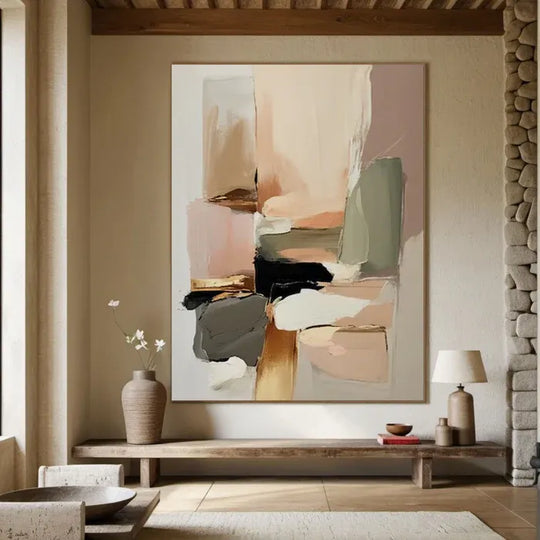
- Muted, earthy palettes — beige, cream, clay, sand, soft grey, charcoal, and warm neutrals.
- Real texture — visible brushwork, palette-knife strokes, and thick impasto you can feel and see catching the light.
- Organic, asymmetric shapes — nothing rigid or perfectly symmetrical.
- Simplicity and negative space — calm compositions that let the room breathe.
- The mark of the human hand — each piece is one of a kind, never a printed copy.
Because these qualities live in the surface of the work, wabi-sabi art is one of the styles where an original hand-painted piece looks dramatically better than a print — the texture is the art. You can see this in our Wabi-Sabi Art collection, where every canvas is hand-painted and finished with a floating frame.
How to style wabi-sabi wall art at home
- Pair it with natural materials — linen, raw wood, stone, ceramics, and plenty of daylight.
- Give it room to breathe — wabi-sabi loves negative space, so resist overcrowding the wall.
- Keep the palette quiet — let one textured piece be the focal point above a sofa or bed.
- Choose the right scale — a single large canvas usually anchors a wabi-sabi room better than several small ones.
Frequently asked questions
Is wabi-sabi the same as minimalism?
No. Both value simplicity, but minimalism aims for clean perfection while wabi-sabi embraces warmth, natural texture, and gentle imperfection.
What colors are wabi-sabi?
Muted, earthy neutrals — beige, cream, sand, clay, taupe, soft grey, and charcoal — rather than bright or saturated colors.
Why is hand-painted better for wabi-sabi art?
Because the beauty lives in the texture and brushwork. A print can only show a flat photograph of texture; a hand-painted canvas has real, light-catching surface that a copy cannot reproduce.
Where can I buy wabi-sabi wall art?
Rosemary Art creates 100% hand-painted wabi-sabi canvases to order, each signed by the artist and shipped framed and ready to hang. Browse the Wabi-Sabi collection or our newest arrivals.
Bring a little calm to your walls
Wabi-sabi art works because it does something a busy world rarely offers: it asks you to slow down and find beauty in the imperfect. Every Rosemary Art wabi-sabi piece is hand-painted, framed, and delivered free in 4–8 working days, with free size and color customization and a 30-day return policy. Explore the Wabi-Sabi Art collection or the full gallery to find the piece that brings your space a sense of quiet.
Continue exploring: Browse our Wabi-Sabi Art collection, see this week's new arrivals, or shop our best sellers — every piece 100% hand-painted, frame included.