
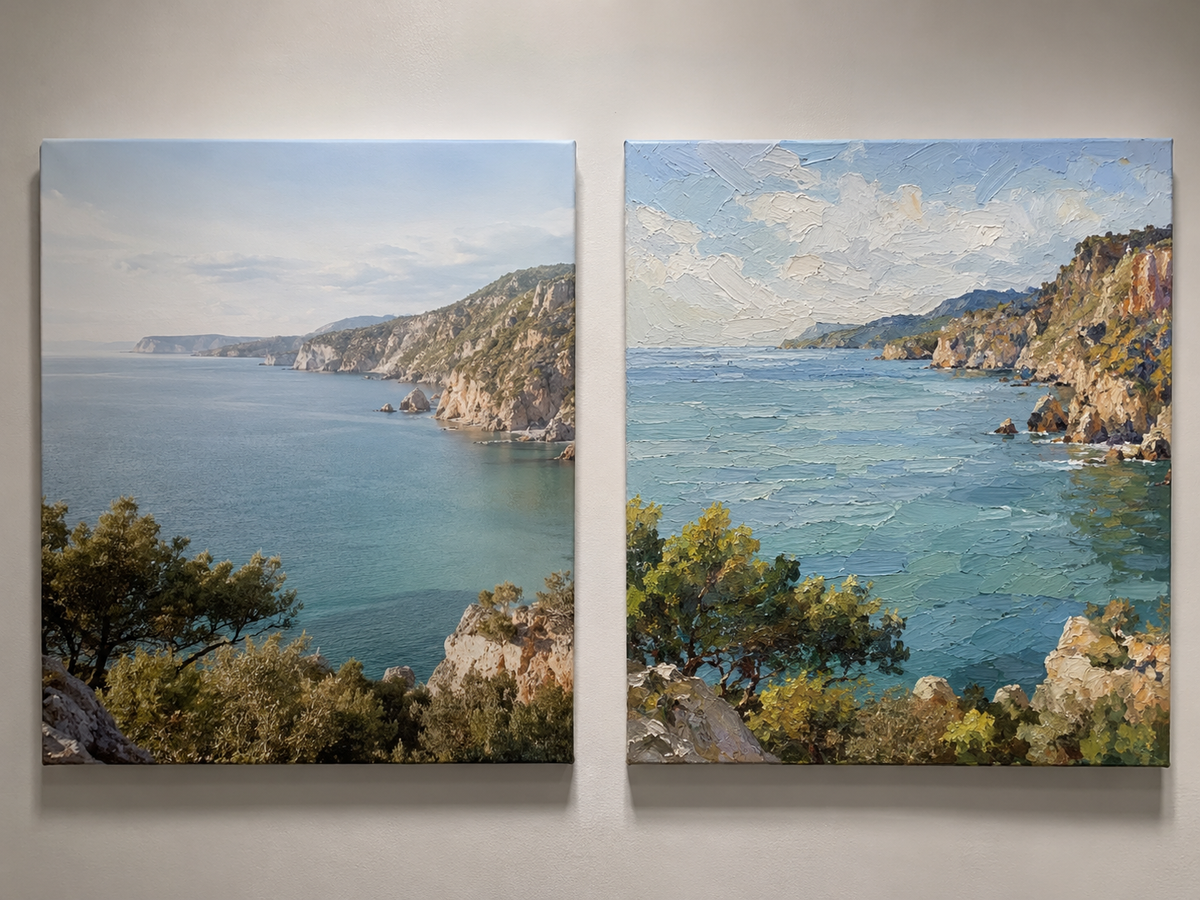

When shopping for wall art, you may find a giclée print and a hand-painted painting with similar colors, compositions, and framing. Which one should you choose—and what will actually be different when it arrives?
The main difference is how the physical image is made. A giclée print is produced using inkjet printing, while a fully hand-painted painting is created through the manual application of paint. The distinction is about production, not simply whether the artwork is displayed on paper or canvas.
Neither category is automatically the better purchase. The right choice depends on whether you value a particular image, physical paintwork, customization, or a combination of these qualities.
This guide explains what to compare before deciding.
What Is a Giclée Print?
A giclée print is a fine-art inkjet print made from a digital file. That file may come from a photographed or scanned painting, a photograph, or digitally created artwork. The image can be printed onto materials such as fine-art paper or canvas.
The word giclée does not, by itself, tell you everything about the finished product. Ink type, the printing surface, and material compatibility matter. Rather than relying on the name alone, ask the seller which inks and paper or canvas are used, especially when durability is an important part of your decision.
A useful product description should make the process clear. You should not have to work out whether you are buying a print or a painting from the room photograph.
What Is Hand-Painted Art?
A hand-painted painting is made by applying paint by hand. However, hand painting is not a single visual style: paint can be applied thinly or thickly, with different approaches producing different surface effects.
Some paintings have prominent brushstrokes and raised areas. Others use thin, translucent layers called glazes. A smooth surface does not automatically mean a painting is printed, just as visible texture does not automatically mean the entire image was painted by hand.
For buyers, the important question is whether paint was used to create the image itself or added to an existing printed image as a finishing treatment.
Giclée Print vs. Hand-Painted Art at a Glance
| Feature | Giclée print | Fully hand-painted painting |
|---|---|---|
| How the image is made | A digital image is output using inkjet printing | The image is created with hand-applied paint |
| Surface appearance | Depends on the printing material and any added finish | Depends on paint application and technique |
| Raised texture | May come from the substrate or additional treatments | May come from built-up paint or other hand-applied materials |
| What to verify | Ink, paper or canvas, edition details, and embellishment | Medium, painting process, and whether the design is repeated |
Printing materials and added coatings can affect a print’s surface, while painting techniques determine whether a painted surface is smooth or heavily textured. The category name is only the starting point.
Does a Giclée Print Have Texture?
Yes—but “texture” can describe several different things.
The Appearance of Texture
A printed image can show the brushstrokes, ridges, and shadows recorded in a photograph of a painting. Those visual details do not necessarily recreate the original painting’s physical relief.
Think of a photograph of a stone wall: you can see the roughness in the image without the photograph having the same depth as the stones. This is the difference between depicting a surface and physically building it.
The Texture of the Material
A print may have genuine surface texture because it is printed on textured paper or woven canvas. The Historic New Orleans Collection identifies both textured cotton-rag paper and canvas among the materials used for inkjet printing. That texture belongs to the support; it does not prove the image was painted.
Hand-Added Texture
A print can also receive paint, gel, or other hand-applied treatments. This is often described as a hand-embellished print. GOLDEN Artist Colors documents ways to add paint and texture to inkjet prints, demonstrating why physical texture alone is not proof of a fully hand-painted composition.
By comparison, impasto painting uses built-up paint layers that can preserve visible brush or palette-knife marks and respond noticeably to light across the surface.
Before purchasing textured art, ask:
“Is the whole image painted by hand, or is this a print with added texture?”
Neither answer makes the artwork unsuitable. An unclear answer makes it harder to judge what you are buying.
Does Hand-Painted Mean One of a Kind?
Not necessarily. A painting can be individually painted by hand while repeating an existing composition. Made-to-order paintings and hand-painted reproductions should therefore be distinguished from works sold as one-of-one originals. Small differences in brushwork do not establish exclusive ownership of a design.
Likewise, giclée does not automatically mean mass-market decoration. Artists also use the process for limited-edition works; the National Gallery has documented a giclée artwork acquired for a public museum collection.
When exclusivity matters, ask a separate question from “Is it hand-painted?”:
“Will this composition be made or sold again, and what exactly does the edition or originality statement cover?”
Clear answers are more useful than vague descriptions such as “unique,” “exclusive,” or “museum quality.”
How Should You Compare Price and Value?
Start with the actual products rather than assuming that one production method should always cost more.
Compare works with similar dimensions and check whether the price includes stretching, framing, delivery, and any requested customization. An unframed print and a framed painting are not directly comparable offers.
Then decide which qualities justify the price for you.
Would you be equally satisfied with the image without hand-applied paint? Is the physical surface a major reason you like the work? Would a particular size or color adjustment make the artwork better suited to your room?
For home decorating, a useful definition of value is straightforward: a piece you enjoy, that fits the space, and that matches its description. Do not treat either “giclée” or “hand-painted” as a promise of future resale value.
Which Lasts Longer: a Giclée Print or a Painting?
There is no reliable lifespan comparison based on those labels alone.
For inkjet prints, preservation depends on the ink, support, and exposure conditions. Paintings also respond to their materials, construction, handling, and environment. Neither process makes an artwork immune to deterioration.
For display at home, avoid direct sunlight, damp locations, and positions exposed to strong heat or rapid environmental changes. Protect paper prints with suitable framing and keep their surfaces from contacting the glazing.
Avoid testing texture by rubbing or scratching the surface. For paintings that need cleaning or repair, seek professional conservation advice rather than applying household cleaning products.
The useful question is not “Which category lasts forever?” It is “What materials are used, and how should this particular artwork be cared for?”
Which Should You Choose for Your Home?
Consider a Giclée Print When the Image Is Your Priority
A print may be the right choice when you have found an image you love in a suitable size, finish, and price range—and you do not need the surface to consist of hand-painted brushwork.
For example, imagine selecting several coordinated images for a hallway. You might prioritize how the compositions work together, the frame dimensions, and the overall budget rather than the presence of raised paint.
Choose the actual print on its merits, not because you feel you must buy a painting to make the room look considered.
Consider Hand-Painted Art When the Paintwork Matters
A hand-painted piece may be a better fit when the act of painting is part of what you want to own.
Imagine choosing one focal artwork above a sofa. You may care about how its brushwork looks nearby, how textured passages catch the room’s light, and whether its colors or proportions can be adjusted. For heavily textured paintings, the interaction between paint relief and light is a real part of their visual effect.
Request close-up images before deciding. Do not choose a painting for dramatic texture unless that texture is present in the specific work you are ordering.
What Should You Check Before Buying Online?
Ask the seller to confirm the production method, materials, dimensions, and framing. For a made-to-order painting, clarify which variations are expected and which features must match your agreed brief.
Request images that answer different questions: a full view for composition, close-ups for surface detail, and a side view for depth and edges. Ask whether the photographs show the exact piece you will receive or a reference version.
Also confirm the production schedule, approval process, and applicable return terms before paying.
For a more detailed inspection guide, read How to Tell If a Painting Is Really Hand-Painted: 8 Reliable Checks.
Exploring Hand-Painted Art at Rosemary Art
At Rosemary Art, our focus is individually hand-painted artwork, including abstract compositions and textured pieces. Our artists work with hand-applied color and surface details rather than relying on a printed image as the finished painting.
For rooms requiring different proportions or colors, our custom hand-painted artwork service offers size, orientation, and palette adjustments, together with a wall preview to help you assess the proposed result.
Explore our hand-painted abstract art to find a starting point, then check the specific work’s finish, dimensions, and available options.
Frequently Asked Questions
Is a Giclée Print the Same as a Canvas Print?
Not exactly. Giclée identifies an inkjet printing process; canvas identifies the material carrying the image. A giclée can be printed on canvas, but it can also be printed on paper.
Is a Hand-Embellished Print Fully Hand-Painted?
No. Hand embellishment adds manual work to a printed image. It should be described as a print with additions, rather than as an entirely hand-painted composition.
Do All Hand-Painted Paintings Have Raised Brushstrokes?
No. Thin applications of paint, including glazing, can create paintings without pronounced raised brushwork. Texture is a feature of the technique, not a universal requirement of painting.
Are Giclée Prints Worth Buying?
They can be. Judge the specific image, materials, presentation, and price against your priorities. A print you genuinely enjoy can be a better purchase for your home than a painting selected only because it is hand-painted.
Final Thoughts
The choice between a giclée print and hand-painted art is not a contest between “real art” and “unworthy decoration.”
Choose according to what you want to own: the image, the hand-created surface, a particular artist’s work, or a piece tailored to your space.
The best purchase is one whose appearance, production method, and price make sense together—with no ambiguity about what will arrive.


