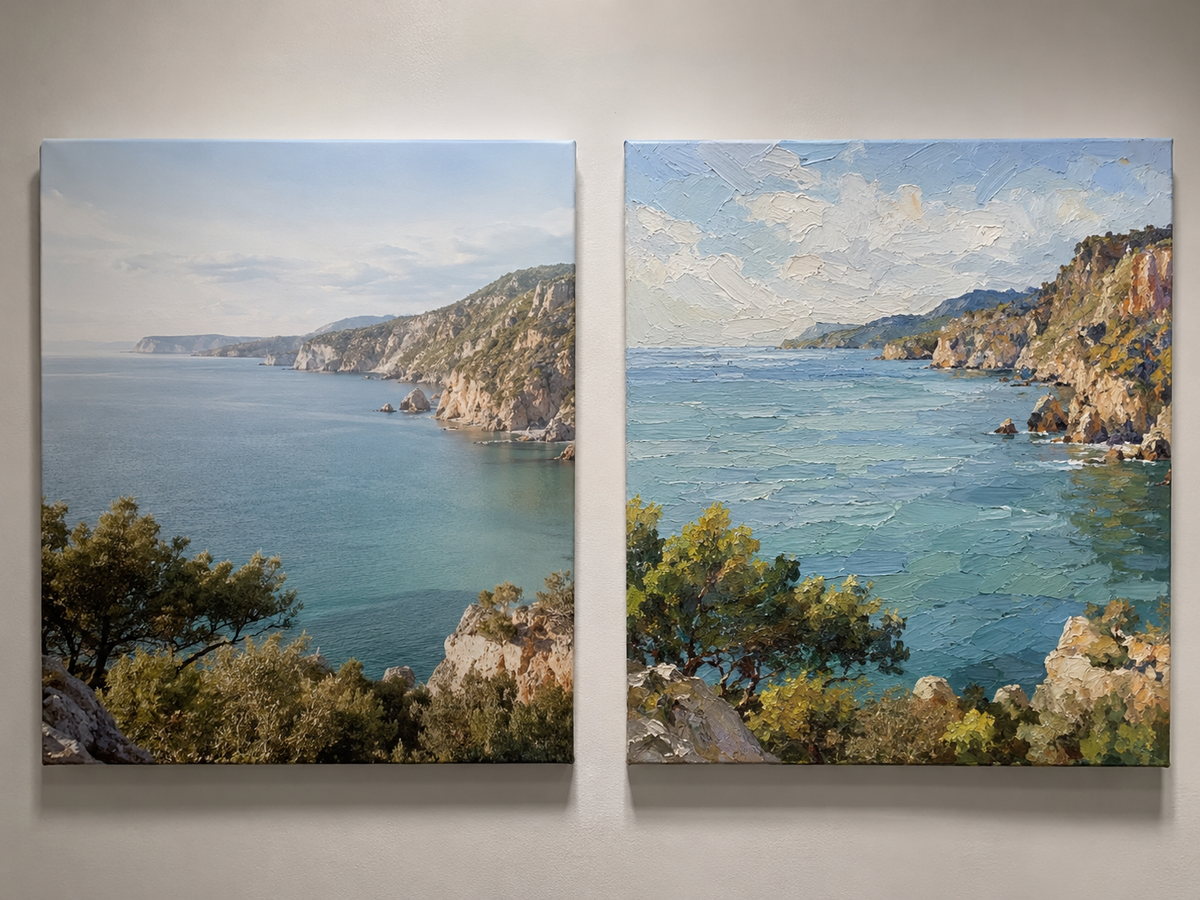
The best wall art for an entryway or hallway is one confident vertical or narrow piece hung slightly higher than usual — a focal painting that sets the tone the second someone walks in — because these are transition spaces, and a single strong image does far more here than a scattering of small frames. Your entry is the first sentence of your home. Make it a good one.
Hallways and entryways get ignored because they're spaces we pass through instead of sit in. But that's exactly why they punch above their weight. Guests form an impression in seconds, and you get a little lift every single time you come home. So it's worth getting the art right.
What kind of art works in an entryway?
Go for impact over subtlety. An entry is usually seen in passing and from a bit of a distance, so a piece with a clear focal point — a striking portrait, a bold abstract, a moody landscape — lands better than something delicate you'd need to stand and study. A single arresting canvas gives the eye a place to land the instant the door opens.

A hand-painted oil portrait like this makes a memorable entry statement — the kind of piece people comment on before they've taken their coat off.
How do I handle a long, narrow hallway?
Hallways are their own puzzle. They're tight, often windowless, and you never see the art straight on — you see it at an angle as you move. A few things that work:
- Use vertical or tall pieces to echo the corridor and draw the eye down its length.
- Hang a consistent center line. Keep the middle of every piece at the same height so the wall reads calm instead of choppy.
- Give texture a job. Narrow halls are low on light, so a hand-textured surface that catches what light there is keeps the space from going flat.
If you want the full room-by-room math on placement, our guide on how high to hang wall art covers the exact heights.
Does texture really matter here?
More than almost anywhere. Entryways and halls tend to be the darkest zones in a home — few windows, borrowed light. A flat print in that setting looks lifeless. A hand-painted, textured canvas does the opposite: the ridges grab every bit of lamplight and daylight and give the wall some quiet motion as you walk by.

A blush sunset tree landscape from the studio — a warm vertical like this suits a narrow entry wall beautifully.
What size and how high should it hang?
In an entry, err bigger than feels safe. A too-small piece on a bare entry wall looks lost. As a rule, fill about two-thirds to three-quarters of the wall space above a console or bench. And because people are usually standing, not seated, when they view entry art, you can hang it a touch higher than the standard 57-inch gallery center — around 60 to 62 inches to the center often sits better over a table.
For a console setup, one large piece or a tight pair reads cleaner than a busy cluster. If you'd rather do two, our sets of 2 are sized to hang together, and the wider full collection has verticals made for exactly these skinny walls.
Why hand-painted holds up in a high-traffic spot
Entryways see bags, coats, weather, and daily bustle, so the art there should feel permanent, not disposable. There's a long tradition of the entry portrait or statement piece announcing a home — the Tate's overview of portraiture is a nice rabbit hole if you're curious about that history.
Everything we make is 100% hand-painted and signed, and it arrives framed and ready to hang. We photograph your finished piece and send it for approval before it ships, so it goes out only once you're happy — and it's never delayed waiting on us. Shipping is free, insured, and about 4 to 8 days, with 30-day returns. Wall a weird width? We customize size and color for free, which is a real gift in oddly shaped entries and halls.
Frequently asked questions
What's the best subject for an entryway painting? Something with a clear focal point that reflects you — a bold portrait, a confident abstract, or an atmospheric landscape. Save the quiet, subtle pieces for rooms where people linger.
How big should entryway art be? Fill roughly two-thirds to three-quarters of the usable wall, especially above a console. In an entry, slightly too big beats slightly too small.
Can I hang art in a hallway with no natural light? Yes — lean into texture so the surface catches artificial light, and add a small picture light or wall sconce if you can.
One big piece or a gallery wall in a narrow hall? In tight halls, a series of evenly spaced pieces on one center line works, but a single large vertical is the easiest way to look intentional.
Your entry deserves better than a bare wall or a forgotten frame. Give it one piece with presence, and watch how differently your home greets you.