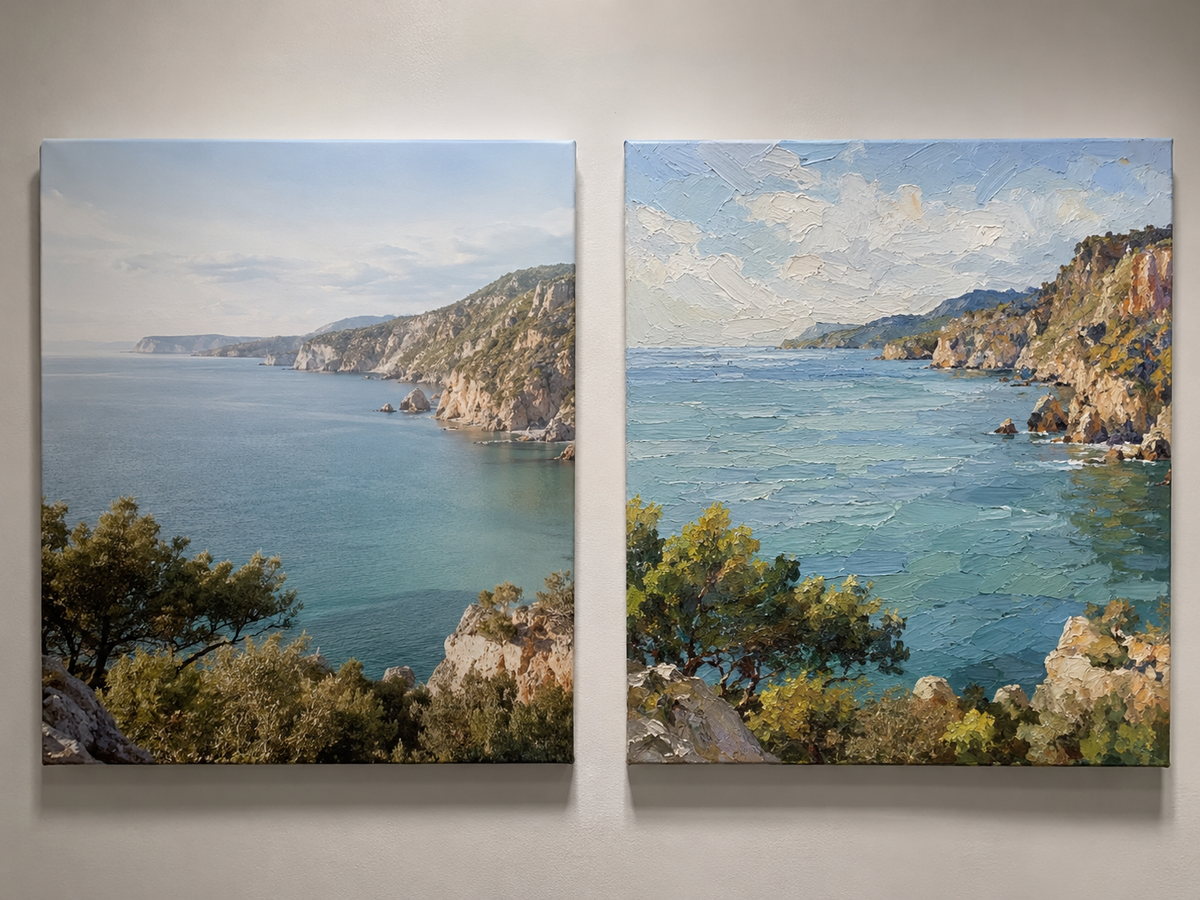
Impasto is paint laid on thick enough to stand up off the canvas and keep the mark of the brush or knife that put it there. Instead of a smooth, flat surface, you get ridges, peaks, and shadows you could read with your fingertips. The word comes from the Italian for “dough” or “paste,” which is about right — the paint is worked more like a material than a stain.
People ask us about “3D” and “textured” art all the time without knowing the actual name for it. So here's the plain version, from someone who paints this way for a living.
What does impasto actually mean?
It's a technique, not a style. Any subject — an abstract, a seascape, a portrait — can be painted with impasto. The defining thing is depth: the paint has real physical relief. Light hits those raised edges and throws tiny shadows, so the piece looks different at noon than it does by a lamp at night. A photograph of an impasto painting always loses something, because a flat image can't carry the shadow the real surface makes. You can read the technical definition in the Wikipedia entry on impasto or the Tate glossary.

Silver impasto abstract on the easel — you can see the paint standing up in ridges, catching the light. Shot mid-process in our studio.
How is an impasto painting made?
Slowly, and with more paint than most people imagine. An artist builds the surface in layers using a palette knife or a stiff brush, letting each pass grab and drag the paint into peaks. Thick oil or heavy acrylic holds those shapes as it dries. It can't be rushed — pile it on too fast and the underlayers stay wet and slump. That build-up time is a big part of why real textured work costs more than a print: you're paying for material and for hours. If you want the full walk-through, we broke it down in how textured paintings are made.
Which famous artists used impasto?
It has a long pedigree. Rembrandt used thick highlights to make a sleeve or a chain catch candlelight. Van Gogh made impasto his signature — those swirling, ridged skies are paint you could almost feel. Later, painters like Frank Auerbach loaded canvases so heavily the paint became sculptural. The point across all of them is the same: texture carries emotion in a way a flat surface can't.
Why is impasto trending in 2026?
Because the internet filled up with perfect, frictionless AI images, and a lot of people got quietly tired of it. Real texture is the antidote — it's obviously made by a hand, it can't be faked in a feed, and it does something a screen never will. That reaction is showing up in sales, not just taste: the global wall-art market sat around $67 billion in 2025 and is forecast to reach roughly $119 billion by 2032, with hand-finished, tactile work leading the pull. Flat prints are easy and everywhere; a surface you want to touch is the thing people are actually spending on. Our 2026 texture trend guide digs into the why.

A white-and-grey impasto landscape — the ridges do the work, giving a near-monochrome piece real presence.
Is impasto the same as “3D” or “textured” wall art?
Mostly, yes — those are the shopping words for the same idea. Just be careful online: some listings sell a flat print of a textured painting and call it “3D.” A printed photo of impasto is still flat; the shadows are printed on, not real. If real relief matters to you, look for the words hand-painted and check for a side or raking-light photo that proves the paint stands off the canvas. Every piece in our 3D textured collection and our abstracts is genuinely built up by hand, never printed.
One honest caveat
Thick paint needs a little respect. Impasto surfaces catch dust in their ridges over the years and don't love being scrubbed — a soft, dry brush is all they need. That's a small trade for a piece that changes with the light and outlasts any print.
Everything we sell is 100% hand-painted and signed, with the real relief you're paying for, and it ships framed and ready to hang. Want a specific size or a color shifted to suit your room? Both are free. You approve a photo of the finished painting before it leaves the studio, so it ships within 24 hours of your yes, arrives in about 4 to 8 days by free insured delivery, and is covered by 30-day returns. See what's just off the easel in new arrivals.
FAQ
What does impasto mean in painting?
Paint applied thickly enough to stand off the canvas and hold the texture of the brush or palette knife, creating real, light-catching relief.
Is impasto done with oil or acrylic?
Both. Traditionally heavy oil paint, but thick-bodied acrylics hold impasto texture well and dry faster.
Is 3D textured wall art the same as impasto?
Usually yes — they describe the same raised, hand-built surface. Watch out for flat prints that only picture texture rather than having it.
How do you clean an impasto painting?
Dust gently with a soft, dry brush. Avoid water and scrubbing, since the raised ridges are more delicate than a flat surface.