Japandi decor is the marriage of Japanese minimalism and Scandinavian warmth — calm, natural, and pared back to only what matters — and in wall art it means one restrained, hand-worked piece that sets the mood of a room instead of a wall crowded with prints. The name is a mash-up of Japan and Scandi. It has been building for years, but heading into 2026 it has become the quiet default for people who want a home that feels settled rather than styled.
I run a small painting studio, so I look at a lot of rooms. And the ones that make me stop are almost never the busy ones. They're the spaces where a single textured canvas does the talking and everything else gets out of the way. That's Japandi in one sentence.
What is Japandi, really?
Japandi pulls from two traditions that turned out to agree on almost everything. From Japan comes wabi-sabi, the acceptance of imperfect, weathered, honest beauty, and ma, the idea that empty space is not wasted space but part of the composition. From Scandinavia comes hygge, that warm, unhurried coziness, plus a love of light wood and function you don't have to think about.
Put them together and you get rooms that are minimal but never cold. Natural materials. Muted color. Room to breathe. If you want the philosophy behind the Japanese half, the wabi-sabi entry on Wikipedia is a solid starting point, and we go deeper in our own guide to wabi-sabi wall art.

One of our beige wabi-sabi abstracts, straight from the studio — the scratch lines and dry-brush marks are exactly the kind of quiet texture Japandi rooms are built around.
What does Japandi wall art actually look like?
Think muted, textured, and singular. The palette is warm but low-key: soft grey, warm white, sand, oat, gentle sage, the browns of raw wood. No neon, no high-contrast graphics fighting for attention. Shapes lean organic and abstract — a horizon, an arc, a soft field of plaster-like texture — rather than sharp geometry.
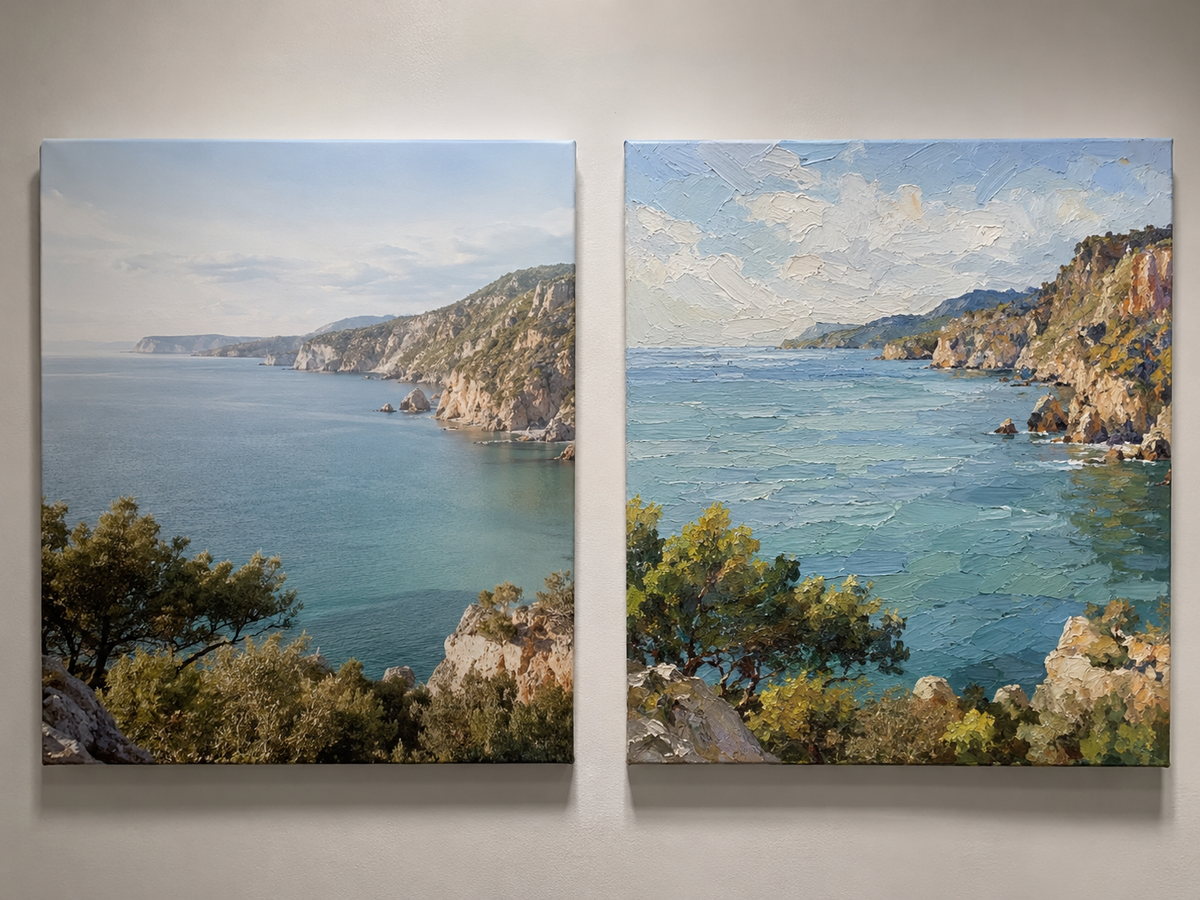
And here's the part people miss. Japandi is about the quality of the few things you own, not the quantity. A muted print off a mass-market site and a hand-painted canvas can photograph almost the same. In the room they are not the same at all. Real paint catches side light. It has ridges and depth and a surface that changes as you walk past. That physical honesty is the whole point of the style, which is why our wabi-sabi collection and 3D textured pieces sit so naturally in a Japandi home.
How do I bring Japandi into my space?
Start with restraint. Pick one wall and one piece. Let it have space around it — that empty margin is doing work. A few things that help:
- Go warm-neutral, then add one grounding tone. Sand and oat walls with a single deeper note — charcoal, clay, muted green — in the art.
- Choose texture over pattern. A plaster-textured abstract reads calmer than a busy graphic, and it ages better too.
- Frame light, or don't frame heavy. Pale oak and thin profiles keep the mood soft. Every Rosemary Art canvas already ships framed, so the proportions are handled for you.
The global wall-art market was worth around $67 billion in 2025 and is on track for roughly $119 billion by 2032, and a real chunk of that growth is people trading up from disposable prints to fewer, better, made-by-hand pieces. Japandi is riding that shift.
Why hand-painted matters for this look
Because Japandi lives or dies on material honesty. A style built on wabi-sabi — the beauty of the handmade and imperfect — falls apart the moment the "art" is a flawless machine print pretending to have texture. The small irregularities in a brushed or knife-worked surface aren't defects here. They're the feature.
Every piece we make is 100% hand-painted and signed, and we send you a photo of the finished canvas for approval before it ships, so nothing leaves the studio until you've seen it. Delivery is free, insured, and takes about 4 to 8 days. If a size or color isn't quite right for your wall, we adjust it at no charge, and there's a 30-day return window. You can browse everything in the full collection or start with what's new.
Frequently asked questions
Is Japandi the same as wabi-sabi? No, but they overlap. Wabi-sabi is a Japanese aesthetic philosophy about imperfect, impermanent beauty. Japandi is a broader interior style that borrows wabi-sabi and blends it with Scandinavian warmth and function.
What colors work best for Japandi wall art? Warm, muted, nature-drawn tones: sand, oat, warm white, soft grey, sage, and the browns of natural wood. One deeper grounding color in the art is plenty.
Can I do Japandi with just one painting? Yes, and often you should. The style prizes empty space, so a single well-chosen textured canvas with room around it is more Japandi than a full gallery wall.
Does Japandi work in a small apartment? Very well. Its restraint and light palette make small rooms feel calmer and more open, not more cramped.
If your home has felt a little loud lately, Japandi is the reset. One honest, hand-painted piece. A wall that finally gets to breathe.