Entryway and Hallway Wall Art: How to Get the First Impression Right
For an entryway or hallway, choose one confident painting hung at eye level (57–60 inches to center) — a vertical piece for a narrow hall, a statement piece on the wall facing the door — rather than a scatter of small frames. First impressions don't come in sets of nine.
Entryways are the most underused walls in most homes. People spend their art budget on the living room, then greet every guest with a bare hallway and a shoe rack. But the entry sets the tone for everything behind it, and it usually needs exactly one good decision.
What makes hallway art different from living room art?
Viewing distance and movement. In a living room, people sit and look at a painting from across the room. In a hallway, they're two feet away and walking. That close range is brutal to prints — you see the dot pattern, the flatness, the fake canvas grain. It's also where real texture shows off most: ridges, knife marks, shadow. If there's one spot in the house where a hand-painted original beats a print on pure physics, it's the hallway.

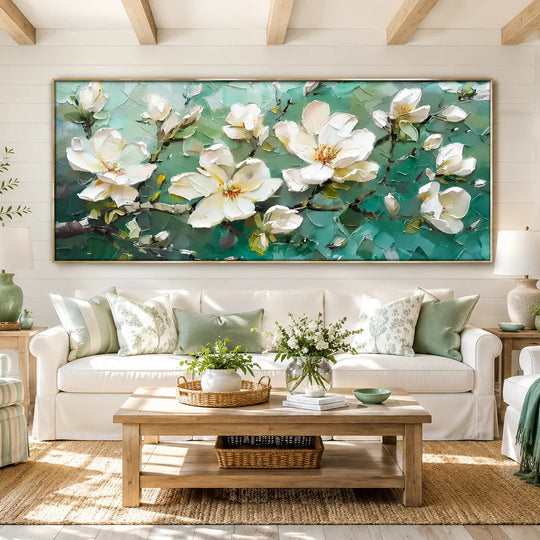
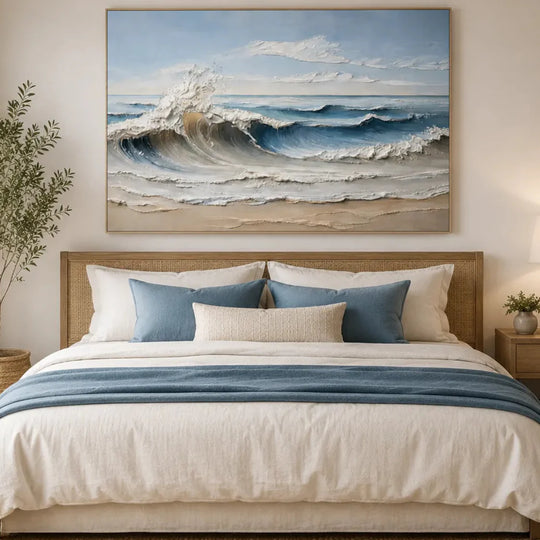
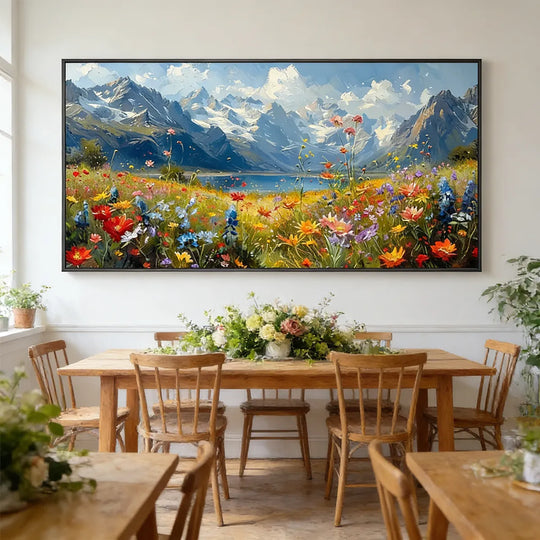
Feather-like impasto in white and silver — the kind of surface that stops people two steps inside the door.
Vertical or horizontal — which way should you go?
Match the wall, not the trend. Narrow walls between doorways want vertical paintings; they add height and make ceilings feel taller. A long uninterrupted hallway wall can take a horizontal piece — or a rhythm of two related works with breathing room between them. The wall directly opposite the front door is the prize spot: whatever hangs there is the first and last thing everyone sees. Give it your best painting, not your leftover one.
How high, and how big?
Center at 57–60 inches — museum eye level. The Met hangs most work near that line for a reason: it's where the eye naturally rests. In halls with furniture (a console, a bench), keep 6–8 inches between the furniture top and the frame's bottom edge. Size-wise, go two-thirds the width of the console beneath it; on a bare wall, err larger — small art on an empty wall reads as an apology. We wrote a room-by-room version of this in how high to hang wall art.
What subjects work in an entryway?
Calm ones with presence. This is a transition space — you want arrival, not agitation. A minimalist tree, a quiet landscape, a textured abstract in soft tones. Save the intense reds for rooms where people linger.

A lone tree in blush pink — shot from the side so you can see the canvas depth a hallway viewer would notice too.
Do hallways get enough light for art?
Often they get the wrong light, which matters more. Harsh downlights directly above a heavily textured piece create dramatic shadows — good if you want drama, distracting if you don't. Warm, slightly angled light flatters texture best. And no, you don't need gallery spots; a hallway painting that needs perfect lighting to work wasn't the right painting.
FAQ
What size art for a narrow hallway? Go vertical, roughly 2:3 or taller. A tall slim painting adds height where floor space can't.
Is original art worth it for a hallway? More than anywhere else — viewers stand closest there, where texture and brushwork are most visible. Every Rosemary Art piece is 100% hand-painted, signed, and arrives with the frame included.
What if standard sizes don't fit my wall? Hallway walls are the most awkwardly sized in any home, which is why our size and color customization is free. You approve photos of the finished painting before it ships — free insured 4–8 day delivery, 30-day returns.
One piece or a gallery wall? In an entry, one. Gallery walls need viewing distance that hallways rarely have.
Start with our 3D textured paintings for close-range impact, or browse new arrivals if you want first pick of what just left the easel.