A

bstract art can attract you before you fully understand why.
A certain combination of color, movement, texture, and empty space may feel calm, energetic, mysterious, or deeply familiar. Yet appreciating an abstract painting and deciding to purchase one are two different experiences.
Many first-time buyers hesitate because they are unsure what the artwork represents, whether it suits their home, or how to judge its quality. The good news is that you do not need formal art training to choose well.
This abstract art buying guide explains how to move from appreciation to acquisition—without relying only on trends, price, or someone else’s opinion.
What Is Abstract Art?
Abstract art does not always attempt to reproduce recognizable people, landscapes, or objects. Instead, it often communicates through color, shape, line, texture, scale, and movement.
The Tate definition of abstract art explains that abstraction may use shapes, colors, forms, and gestural marks rather than accurately representing visual reality.
This means an abstract painting does not have to show a clear subject to create meaning. Its value may come from how it changes the atmosphere of a room or how it makes the viewer feel.
Some abstract paintings are quiet and minimal. Others are expressive, layered, and highly textured. Neither approach is automatically better. The right choice depends on your personal response and the space in which the artwork will be displayed.
How to Appreciate Abstract Art
Before asking how to buy abstract art, spend time learning how to look at it.
Do not begin by asking, “What is this supposed to be?” That question can limit the experience. Instead, pay attention to what the painting does visually and emotionally.
Consider the following:
- Where does your eye move first?
- Which colors dominate the composition?
- Does the artwork feel controlled or spontaneous?
- Is the surface smooth, layered, rough, or heavily textured?
- Does the painting create calm, tension, energy, balance, or movement?
- Would you still enjoy looking at it after the initial surprise disappears?
The Museum of Modern Art’s overview of abstraction provides useful background on how artists move away from direct representation and use visual elements as the subject of the work.
You do not need to discover one correct interpretation. Abstract art can create different associations for different viewers.
Start with Your Personal Response
One of the biggest mistakes first-time buyers make is choosing artwork only because it matches the sofa, follows a current design trend, or looks impressive in a styled photograph.
Interior compatibility matters, but it should not be the only reason you purchase a painting.
Ask yourself three direct questions:
- Would I still like this painting in a different room?
- Does it create an emotional response beyond matching my décor?
- Can I imagine living with it for several years?
A successful purchase usually sits between personal connection and practical suitability.
The painting should belong in the room, but it should not disappear into the room.
Identify the Abstract Style You Prefer
Abstract art covers many visual directions. Understanding your preference will make the buying process faster and more consistent.
| Abstract style | Common visual qualities | Suitable interiors |
|---|---|---|
| Minimal abstract | Soft colors, restrained forms, open space | Modern, Japandi, minimalist |
| Gestural abstract | Visible brush movement, energetic marks | Contemporary, industrial, eclectic |
| Geometric abstract | Structured shapes, strong lines, repetition | Mid-century, modern, office |
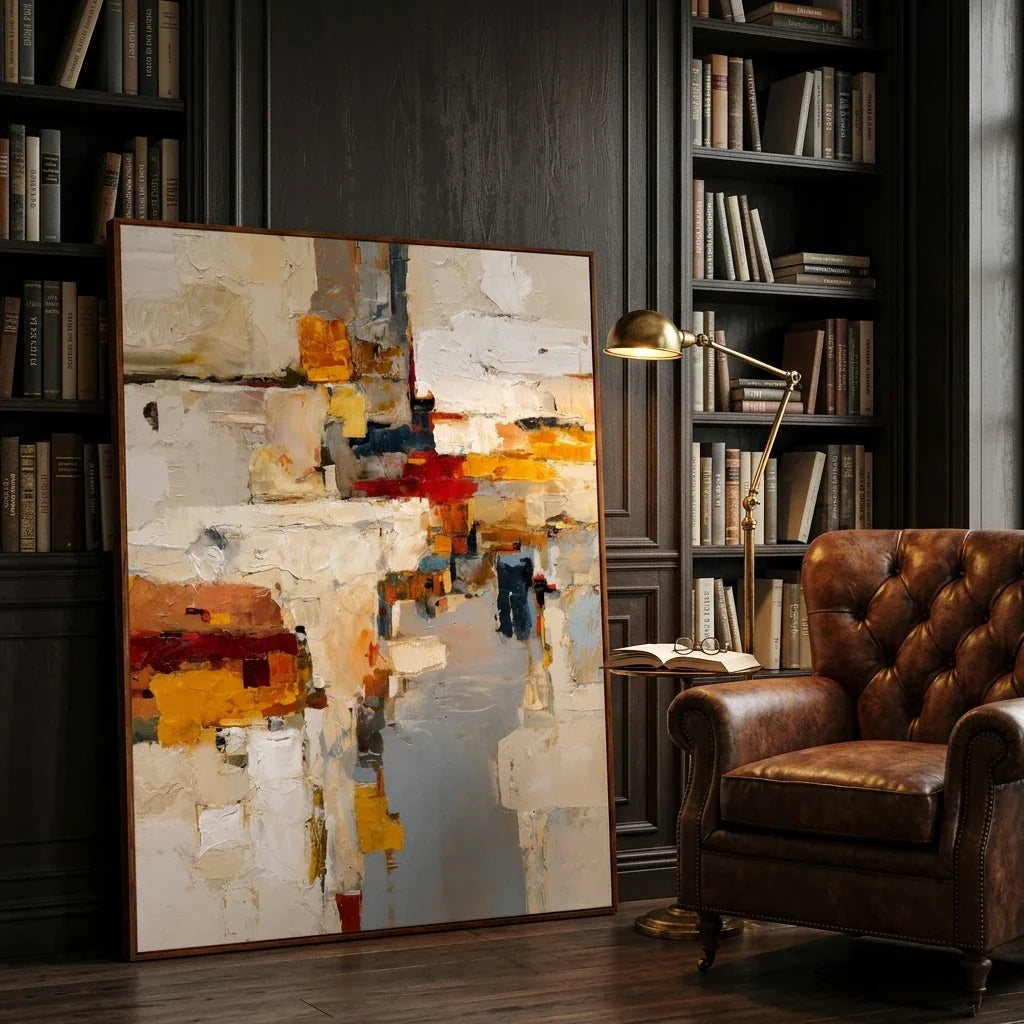
| Textured abstract | Raised surfaces, layered paint, tactile detail | Organic modern, luxury, wabi-sabi |
| Color-field abstract | Large areas of color, gradual transitions | Calm bedrooms, living rooms, hospitality |
| Monochrome abstract | Limited color palette, emphasis on form | Minimalist, sophisticated interiors |
You may notice that you consistently respond to certain elements, such as warm neutrals, deep blue tones, visible brushwork, or sculptural texture.
Use those preferences as a filter rather than beginning with thousands of unrelated options.
You can explore different approaches in Rosemary Art’s hand-painted abstract art collection.
Original, Hand-Painted, Printed, or Textured?
Not all abstract wall art is produced in the same way. Understanding the difference is essential when learning what to look for when buying abstract art.
| Artwork type | How it is made | Main characteristics |
| Hand-painted artwork | Paint is manually applied by an artist | Visible brushwork, natural variation, physical depth |
| Textured painting | Paint or texture medium creates a raised surface | Strong tactile quality and changing shadows |
| Embellished print | Printed base with limited hand-applied detail | More affordable, partly handmade |
| Standard art print | Image reproduced mechanically | Flat surface, consistent reproduction |
| Custom painting | Created or adjusted for a specific buyer | Personalized size, color, composition, or texture |
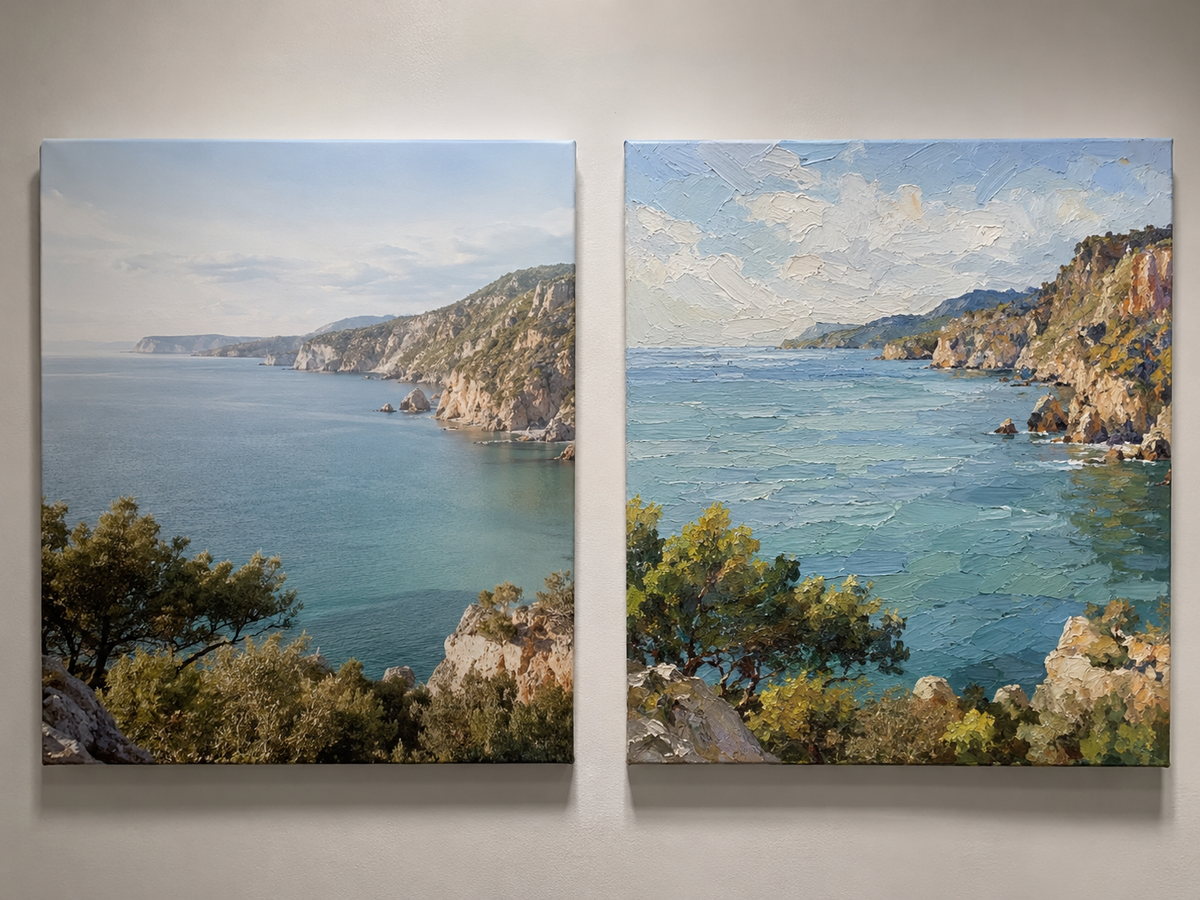
A hand-painted abstract painting usually has subtle irregularities that reveal the physical process. Brush pressure, layering, edge variation, and texture will not appear perfectly mechanical.
That does not mean every hand-painted work is automatically high quality. Materials, composition, finishing, stretching, framing, and consistency still matter.
For interiors where surface depth is important, consider exploring 3D textured paintings. Raised areas interact with natural and artificial light, allowing the artwork to look different throughout the day.
How to Judge the Quality of Abstract Art
A strong abstract painting should appear intentional, even when the brushwork looks spontaneous.
Look closely at the following areas.
1. Composition
The elements should feel visually balanced. Balance does not mean perfect symmetry. A painting can be asymmetrical and still feel stable.
Pay attention to whether one area feels accidentally empty, overly crowded, or disconnected from the rest of the composition.
2. Color Relationships
Colors should interact with purpose. Look for depth, contrast, transitions, and supporting tones rather than a collection of unrelated fashionable colors.
3. Brushwork and Layering
Visible brushstrokes should contribute to movement, structure, or texture. Random marks without visual control may create temporary impact but often become tiring over time.
4. Surface Quality
For textured abstract paintings, inspect close-up photographs. Texture should have variation and direction rather than appearing as a uniform decorative coating.
5. Edge and Finish
Check the sides of the canvas, corners, stretcher bars, frame joints, and hanging hardware. These practical details affect the durability and final presentation of the work.
How to Choose Abstract Art for Your Home
A painting can be visually impressive but still be wrong for a particular wall.
Before purchasing, consider size, orientation, color, viewing distance, lighting, and surrounding furniture.
Choose the Right Size
Artwork that is too small often looks disconnected from the furniture beneath it. Artwork that is too large can make a room feel crowded.
For art above a sofa, console, bed, or sideboard, the artwork should generally relate clearly to the width of the furniture.
Use this simplified reference:
| Placement | Suggested relationship |
| Above a sofa | Approximately 60–75% of the sofa width |
| Above a bed | Approximately 60–80% of the headboard width |
| Large empty wall | One oversized piece or a coordinated multi-panel arrangement |
| Narrow wall | Vertical artwork |
| Long wall | Horizontal artwork or a diptych/triptych |
These are starting points, not absolute rules. Ceiling height, furniture scale, and surrounding negative space also matter.
Match the Mood, Not Every Color
Your painting does not need to contain the exact same colors as your cushions, rug, or curtains.
A more sophisticated approach is to repeat one or two supporting tones while allowing the artwork to introduce contrast.
For example:
- A beige room can benefit from black, rust, blue, or olive accents.
- A dark room may need lighter tonal variation or metallic detail.
- A colorful room may work better with a restrained abstract painting.
- A minimalist room can support a highly textured neutral piece.
The goal is visual connection, not perfect color duplication.
Consider Orientation
Horizontal abstract art usually works well above sofas, beds, and dining furniture.
Vertical artwork is better suited to narrow walls, staircases, reading corners, and spaces between windows.
Square artwork creates a stable, balanced impression and can work well in entryways or above compact furniture.
How to Buy Abstract Art Online Safely
Buying artwork online is convenient, but product presentation can hide important details.
Before placing an order, verify the following:
- Is the artwork hand-painted, printed, or hand-embellished?
- Are close-up texture photographs available?
- Are the listed dimensions for the canvas or the framed artwork?
- Is the painting sold framed, unframed, or rolled?
- Can the color and composition vary from the product photograph?
- Is progress approval available for custom work?
- What is the production time?
- How is the artwork packaged?
- What happens if the painting arrives damaged?
- Are returns or adjustments possible?
For handmade work, slight variation is normal. However, the seller should explain how closely the finished artwork will follow the reference image.
Reliable sellers should also provide clear communication before production and photographs or videos when appropriate.
When Custom Abstract Art Makes Sense
Sometimes you find the right visual style but the wrong size, orientation, or color balance.
Custom artwork is useful when:
- The wall requires an unusual proportion.
- A standard size looks too small or too large.
- You need specific colors for a design project.
- You want a horizontal version of a vertical composition.
- A hotel, office, or commercial project requires multiple coordinated pieces.
- You want the artwork to respond to an existing interior palette.
Rosemary Art offers custom abstract artwork, including adjustments to size, color, composition, texture, and framing.
A custom painting should not simply copy a room’s colors. The better approach is to preserve the artwork’s visual strength while adjusting the elements that affect spatial compatibility.
Should Abstract Art Be Considered an Investment?
For most home buyers, abstract art should first be purchased for enjoyment, atmosphere, and personal value.
Some artworks increase in financial value, but predicting future appreciation requires knowledge of the artist’s market, provenance, exhibition history, documentation, and collector demand.
Decorative hand-painted artwork and investment-grade fine art are not automatically the same category.
Therefore, do not allow vague promises of future value to replace a careful evaluation of quality, authenticity, and personal relevance.
Buy the piece because it improves your environment and because you want to continue looking at it.
A Practical Abstract Art Buying Checklist
Before purchasing, confirm the following:
| Question | Why it matters |
| Do I feel a genuine connection to it? | Prevents trend-based impulse purchases |
| Does the size suit the wall? | Protects visual proportion |
| Is it hand-painted or printed? | Clarifies product value and surface quality |
| Have I seen close-up details? | Reveals brushwork and texture |
| Does the palette support the room? | Creates harmony without overmatching |
| Is the orientation correct? | Helps the painting fit the architecture |
| Is framing included? | Prevents unexpected additional costs |
| Is packaging explained? | Reduces shipping risk |
| Can it be customized? | Solves size or color limitations |
| Is the return or damage policy clear? | Protects the purchase |
Final Thoughts
Learning how to buy abstract art is not about memorizing art terminology or following strict interior design rules.
It is about combining three forms of judgment:
- Your emotional response
- The quality of the artwork
- Its relationship to the space
Begin by identifying the colors, textures, and compositions that consistently attract you. Then evaluate the physical construction, dimensions, materials, and seller information.
The right abstract painting should do more than fill an empty wall. It should create a visual presence that continues to hold your attention after the room has been fully decorated.
Explore Rosemary Art’s abstract art collection, or contact the studio for help choosing a size, style, or custom painting for your space.
Frequently Asked Questions
How do I choose abstract art for my home?
Start with the mood you want to create, then consider size, orientation, color relationships, texture, and viewing distance. Choose a painting that complements the room without simply copying every existing color.
How do I know if an abstract painting is good?
Look for intentional composition, controlled color relationships, convincing brushwork, quality materials, balanced visual movement, and professional finishing. Strong abstract art should feel purposeful even when it appears spontaneous.
Is it safe to buy abstract art online?
It can be safe when the seller clearly explains the materials, production process, dimensions, packaging, shipping, and return conditions. Always inspect close-up images and confirm whether the artwork is hand-painted or printed.
Should abstract art match the room?
It should relate to the room, but it does not need to match every color. Repeating one or two tones is usually enough. Contrast can make the artwork more visually effective.
Is hand-painted abstract art better than a print?
It depends on your priorities. Hand-painted art offers physical brushwork, texture, variation, and a stronger sense of craftsmanship. Prints are usually more affordable and consistent but lack the same surface depth.
Can abstract art be customized?
Yes. Custom abstract wall art can often be adjusted in size, orientation, color palette, texture, and framing. Customization is especially helpful for oversized walls and unusual room proportions.