Does Original Art Hold Its Value? An Honest Answer From a Working Studio
Most original paintings will not make you money, but they hold their value in a way a print never can: a hand-painted canvas is still worth living with in thirty years, while a poster is worth nothing the first time it creases. That is the honest version of the answer, and it is the one I give every time somebody emails the studio asking whether a painting counts as an investment.
I run a painting studio. I am not an auction house, and I am not going to tell you the piece above your sofa is a retirement plan. But "investment" is a slippery word, and it means two very different things depending on who is saying it. Worth separating them before you spend anything.

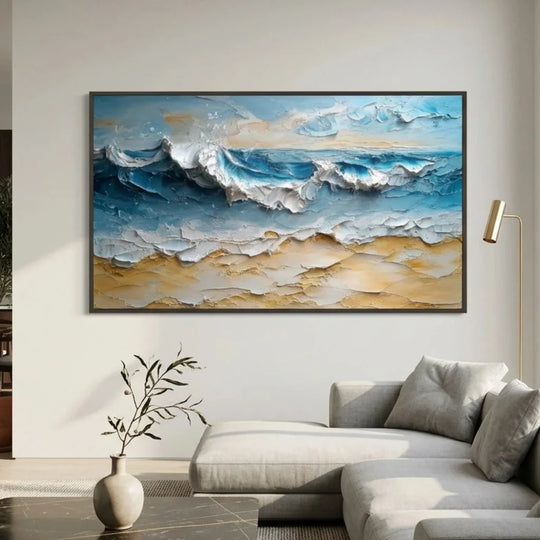
Thick impasto like this is the part a photograph can't fake — and it's also the part that makes a painting an object rather than a picture.
Does original art actually go up in price?
Sometimes. Rarely. And almost never in a way anyone can predict from the sofa.
The market people picture when they hear "art as an investment" is the secondary market — auctions, dealers, resale. Prices there are driven by the artist's name, exhibition history, and provenance, meaning a documented chain of ownership going back to the studio. Take away the name and the paperwork and you take away almost all of the resale premium. That is why two paintings of similar quality can be worth $900 and $90,000.
Decorative original art — which is what most of us actually buy, including most of what we make — sits outside that system. It is bought to be lived with. And the numbers back that up: the global wall art market sat around $67 billion in 2025 and is projected to reach roughly $119 billion by 2032. That is not speculation money. That is people wanting their rooms to feel like something.
So if a seller tells you a painting is "guaranteed to appreciate," that is a sales line, not a forecast. Nobody guarantees that. Art valuation is a whole discipline precisely because the answer is never obvious.
What "holding its value" really means for a painting
Here is the framing I find more useful. Forget resale for a second and think about cost per year of living with the thing.
A $400 original hung for fifteen years costs you under $30 a year. A $60 framed print that you get bored of and replace every three years costs you $20 a year — and at the end of fifteen years you own nothing, because the last one is a curled sheet of paper in a snapped frame. The original is still on the wall. It can move house with you. It can go to a child. It can be re-hung in a completely different room and read as new.
That is what holding value looks like for almost everyone reading this. Not a return. A refusal to depreciate.
Which original paintings tend to keep resale value?
If resale genuinely matters to you, a few things move the needle:
- A signed, traceable piece. A signature plus a record of where it came from is the difference between "a painting" and "that painting." Everything we ship is hand-painted and signed, and we send you photographs of your actual canvas for approval before it leaves.
- Physical soundness. Decent canvas, a stretcher that won't warp, pigments that don't shift. A painting that survives is a painting that can still be sold.
- Something people want to live with. Difficult subjects and awkward sizes shrink the pool of future buyers. Neutral, textured, large-ish work sells on.
- Condition. Uncracked, unfaded, unrestored. This one is entirely in your hands after delivery.
Notice how little of that is about the artist being famous. Most of it is about the object being good and being looked after.

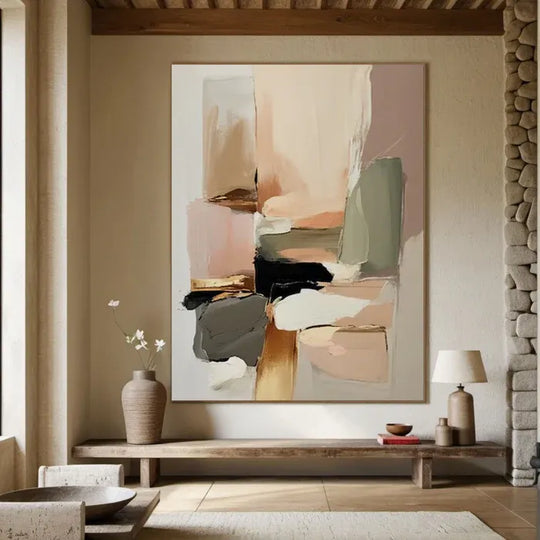
Neutral, textured, quietly confident — the kind of piece that stays wanted across several changes of furniture.
What destroys a painting's value fastest?
Sunlight, damp, and enthusiastic cleaning. In that order.
Direct afternoon sun will lift colour out of a canvas within a few years — we wrote a whole piece on whether paintings fade in sunlight because it comes up constantly. Damp is slower but nastier: it warps stretchers and lifts paint. And more paintings are wrecked by somebody attacking them with a wet cloth and household spray than by any of the dramatic things people worry about.
None of this requires special equipment. It requires knowing not to hang a painting opposite a west-facing window and not to reach for the glass cleaner.
Why texture is suddenly worth more to people
There is a shift happening that I did not expect three years ago. As AI-generated images flooded every feed, the value people place on visibly hand-made objects went up rather than down. Texture became the proof. You can generate a flawless picture in four seconds; you cannot generate a ridge of paint that catches raking light at seven in the evening.
That is the whole logic behind the 3D textured paintings people keep asking us for. Not nostalgia — evidence.
So should you buy art as an investment?
No. Buy it because you want to look at it every day for a long time. If it also happens to be worth something later, treat that as a bonus you didn't pay for.
The honest caveat: if your actual goal is financial return, art is a poor vehicle for it — illiquid, expensive to sell, and dependent on a reputation market you have no control over. Put the money somewhere designed for the job. Then buy a painting with different money, for different reasons.
Common questions
Is a hand-painted piece worth more than a print of the same image?
As an object, yes, and by a wide margin — it's unique and physically unreproducible. As a financial asset, both are usually worth roughly nothing on resale unless the artist has a market.
Does a certificate of authenticity increase value?
It helps establish provenance, which matters. It is not magic on its own. A signature, studio photographs, and a purchase record do most of the same work.
Will a custom-size or custom-colour painting be harder to resell?
Slightly, if you go very unusual. But custom sizing and colour changes are free with us, and I'd rather you own something that fits your wall properly than something you tolerate. Living with it well is the return.
How long does delivery take?
Every piece ships after we send you photographs of your finished canvas and you approve it, so nothing arrives as a surprise. Delivery is free and insured, typically four to eight days, with a frame included and thirty days to return it.
If you want to browse with all of that in mind, start with the abstract collection or just look at what's newest and see what stops you.